
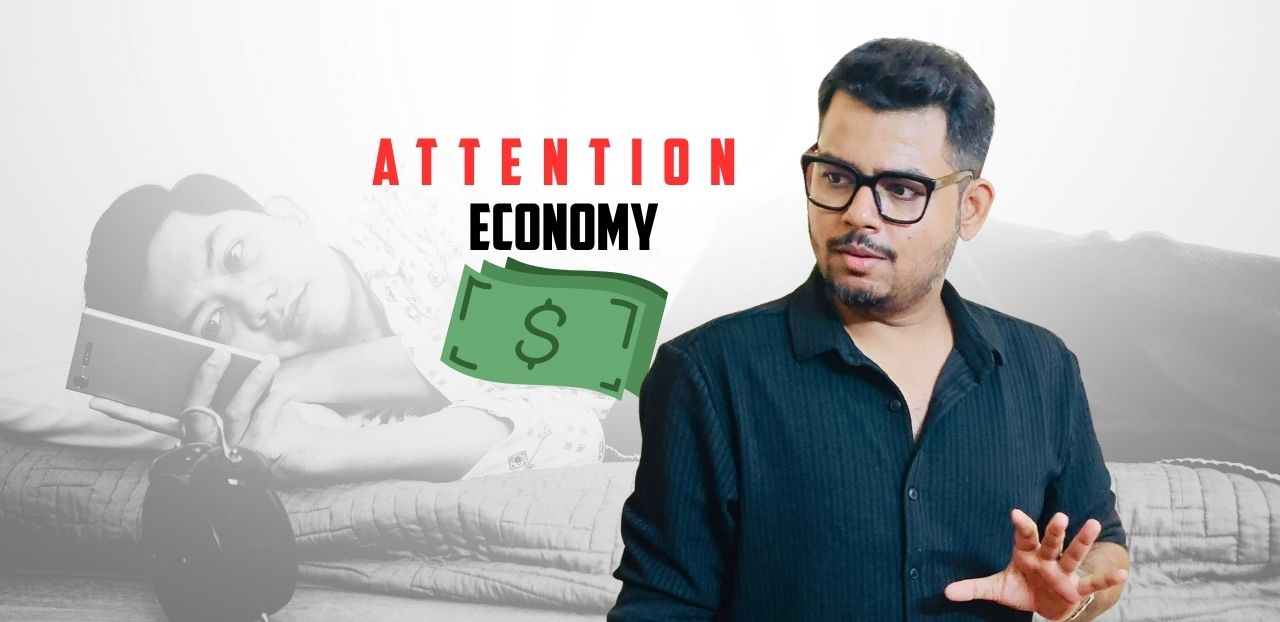



The Attention Economy – A Psychological Heist

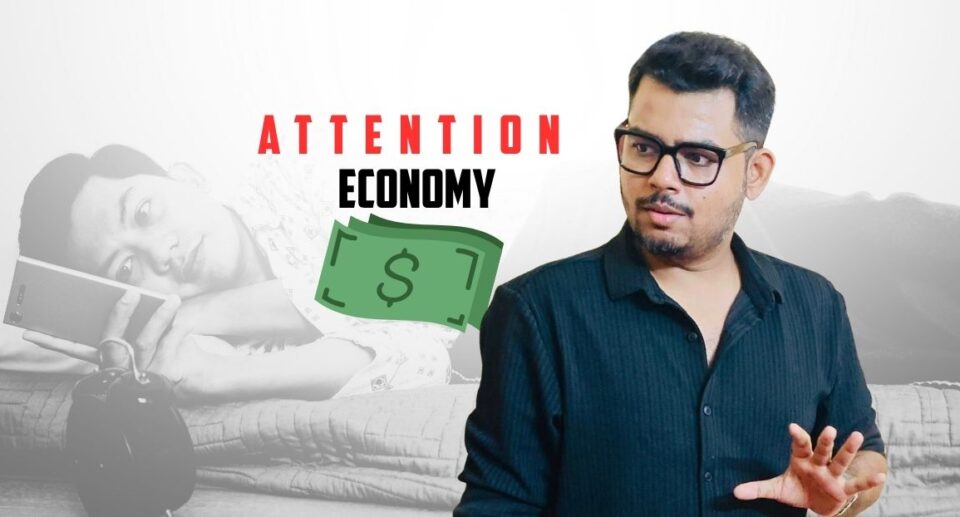
You picked up the phone to read an email notification, 27 minutes later you are watching a video of a cat opening a window. You have no idea where the time went. We humans have become worse than a goldfish. Everytime the dopamine hits you, you keep scrolling or refresh your feed. At times when they show you, ‘you’re all caught up!’, somewhere deep down you feel unhappy about it. You need more, and more, and more.
The biggest difference between the past and today’s time is the role reversal of ‘focus’ and ‘information’. It’s an economic shift that slided from scarcity to abundance with the digital era. In the past, there was scarcity of information and we used to pay for access. I remember my father subscribing to 3 daily newspapers to keep himself updated. But now, information is infinite, focus is finite. Tech companies are not trading information anymore, they are capturing user’s focus and reselling it to the advertisers. That’s the pure modern day model of any big public digital platform. Even food-tech companies are selling ad spaces to engage users while they wait for their order.
You might see innovation in ad penetration but the concept is much deeper. Let me break it down. Your life is finite, and you only have so much to live, do your work, achieve something worth your efforts – but plot twist, your screen time is saying a different story. You have distributed 3 hours to Netflix, 4.5 hours to blind social media scrolling across apps (Instagram, Snapchat, Facebook, etc.) and 2 hours into messaging and sharing photos / videos on WhatsApp. Now add another hour into a variable – Spotify or YouTube. If you now add the numbers up, you will realise you have spent more than ten hours of your active time in doing things that mostly won’t be helping you with any of your life goals (unless your job actually needs you to do any of the above). Now multiply that figure with the number of days you think you are going to repeat this pattern; and the final number will scare you! But you do not realise this until you intervene your own decision and recognise the pattern.
This is a planned design framework that puts you into a dark pattern of infinite scrolling (no definite end of the content flow until you stop) and variable rewards that feed on your dopamine (pull down to refresh for surprise). Don’t you think such big tech companies could have easily fixed a problem of needing to pull down to refresh – instead they could have just refreshed the feed after a certain time. But that microsecond of you waiting to see what’s there after your refresh hits your dopamine so hard that you are glued again for another 30 minutes on the app. And that is a clear example of stealing or hijacking your attention, your focus. Consider yourself as a human with a leash around your neck, a leash in the form of ‘notifications’.
Every time you hear a ping, your brain releases a tiny squirt of cortisol. You are not “checking” a message. You are being interrupted. The architects of the attention economy have rigged the game so that your distraction is their dividend. Consider the “refresh” action. Sometimes you get a like (reward), sometimes nothing (loss). This variable schedule is neurologically identical to a slot machine.
But you might say “so what?”. Before you say that, think about the cost, not in monetary terms but in terms of long term impact. There was a time we used to remember phone numbers, we used to read books. What happened to that? Numbers are still there, books are still there, but your focus is not there. It has taken shape of FOMO (fear-of-missing-out), in simple words – ‘anxiety’. People are suffering from chronic distraction which are switching off their abilities to focus for a longer span of time, eventually your speech rate increases, you feel you are unable to catch up and that anxiety leads to more depression and more scrolling, and the loop continues. Now on the other side of this story, the content strategists, the political organisations, the advertisers make use of this chronic distraction to provoke collective outrages, political polarisation without the intervention of rational thinking. That’s why these days its so easy to create outrageous sentiments across social media over certain issues – but if you dig deeper, you will find the control is in the hands of someone with an agenda and you are just doing their work for free, losing your own mental stability.
Finally, the social instability of judgement and normalisation of almost anything – be it vague cultural shifts in the name of modernity, losing value systems in the name of sexual choices, breaking families in the name of normalised adultery – all driven by influential content, that’s getting injected in the society mostly through youngsters. In diplomacy and the art of war, it is said, if you have to break a country, first break their education systems and then the society. If families break, you have a broken society and that’s exactly what’s happening. People are suffering from anxiety deep down by seeing others in their picture-perfect worlds, whereas those people posting the picture-perfect worlds are themselves tired of producing the same content just because their audience likes it. Now where is the legitimacy? But do you care?
We are living in a paradoxical world. The companies that claim to connect the world are actually operating on a business model that drives revenue and direct monetary incentives from keeping you anxious, alone and endlessly scrolling. This is nothing but a psychological heist – that questions your own existence, your likings, dislikings. Even your likes are converted into dopamine triggers. People are not concerned about how many people they are reaching on social media, they are concerned about the number of likes. The value of everything has become equivalent to numbers and engagement rate – to the extent that large corporations actually buy fake likes and followers to capture more attention. Remember the story of the Pied Piper? Can you picture yourself fitting into that story anywhere? Where exactly! I know you know the answer.
The only radical thing you can do in the modern times to counter this without leaving the internet is to try and read something for straight 20 minutes without checking your phone! I know when I blog, I write it directly on my website, there are no drafts elsewhere. So it takes time. While I am writing this article, I didn’t realise it has already been 40 minutes and I am proud of it. So the fix is called willpower. Only willpower can defeat the algorithm. While as a digital marketing strategist myself we often use these social loopholes of the modern world to our client’s advantage, I genuinely feel there must be a balance of some sort. Else the internet will soon become a cemetery of bots and lifeless virtual profiles who will only be connected through an electronic device but societal connections will become non-existent.